

Introduction
Most e‑commerce brands analyze competitors at the surface level: prices, photos, descriptions, and maybe a few reviews. That approach never reveals why a product succeeds or fails, nor does it expose the structural weaknesses that silently destroy conversion. AI changes the dynamic because it doesn’t just read data—it interprets patterns. When you understand where your competitors are failing, you can position your product as the obvious choice without increasing ad spend or expanding your catalog.
Why competitor flaw detection matters
Products in e‑commerce don’t compete on features alone. They compete on clarity, trust, friction, and perceived value. A competitor can offer a lower price and still lose sales because their messaging is confusing, their attributes are incomplete, or their reviews reveal recurring frustrations. AI can process thousands of signals in minutes, identify patterns that humans overlook, and translate them into actionable advantages. This type of analysis doesn’t just reveal flaws—it reveals market openings that your competitors are unintentionally creating.
How AI uncovers product weaknesses competitors don’t see
Finding hidden patterns in reviews and customer feedback
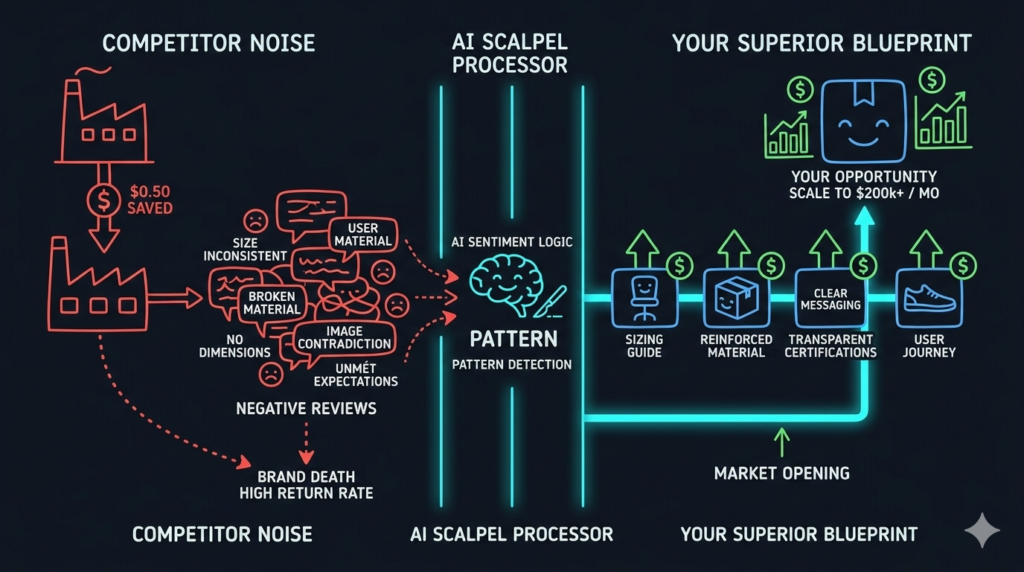
Reviews contain the truth competitors try to ignore. AI can cluster recurring complaints, detect emotional triggers, identify unmet expectations, and reveal contradictions between what the product promises and what it delivers. The common mistake is focusing on the average rating, when the real insight lies in the language, sentiment, and repetition. This is where structural product flaws become visible and where differentiation opportunities emerge.
Deep attribute comparison across competing products
Most brands compare products by price or aesthetics, but not by the attributes that actually influence purchase decisions. AI can extract product characteristics, detect missing information, compare depth of detail, identify inconsistencies across variants, and evaluate the clarity of the value proposition. The assumption that “all products are the same” collapses when AI highlights gaps in materials, certifications, benefits, or technical details that competitors fail to communicate.
Analyzing positioning and value proposition coherence
AI can read product pages, ads, FAQs, and category descriptions to understand what competitors promise, what they prioritize, what they sacrifice, and what they misunderstand about the customer. This is where your Expert Edge becomes critical: AI doesn’t just compare products—it compares mental models. It reveals strategic misalignments between what the competitor thinks the customer values and what the customer actually experiences. A competitor may have a strong product, but if their narrative is incoherent, you can capture the buyer’s intent with a clearer message.
Detecting invisible friction in the buying experience
AI can simulate the user journey and identify unnecessary steps, confusing information, weak social proof, contradictions between images and text, unclear variant logic, and moments where the user hesitates. These frictions are not technical errors, but they are responsible for most abandoned carts. Identifying them allows you to build product pages that feel more trustworthy, more intuitive, and more aligned with the buyer’s intent.
Practical examples of AI‑driven flaw detection
Example 1
A competitor has thousands of reviews. The typical mistake is checking only the average rating. AI clusters the complaints and reveals that 70% mention inconsistent sizing. That pattern exposes a structural flaw you can exploit with a more accurate sizing guide or a recommendation engine.
Example 2
Two products appear identical. The mistake is comparing only price. AI detects that one product fails to mention materials or certifications, reducing buyer confidence. That gap allows you to position your product as the safer, more transparent option.
Example 3
A product page looks complete. The mistake is assuming it’s optimized. AI identifies contradictions between the images and the written dimensions, creating distrust. That inconsistency explains the low conversion rate.
Example 4
A competitor has strong branding. The mistake is assuming that branding compensates for everything. AI reveals that the value proposition contradicts the reviews, exposing a gap between promise and experience.
Common mistakes in competitor analysis
Many brands analyze only prices, review product pages without context, copy competitor attributes, ignore negative reviews, overlook variant inconsistencies, fail to evaluate message clarity, skip FAQs, ignore ads, and never study category‑level strategy. These mistakes turn competitor analysis into a superficial exercise that misses the real opportunities.
The right strategy for identifying competitor flaws with AI
Core principles
Effective analysis focuses on patterns, not isolated data points. It looks for contradictions, not just missing information. It prioritizes clarity over quantity. And it centers on the elements that influence buying decisions, not vanity metrics.
The process
Start by extracting and clustering reviews. Compare attributes across competing products. Evaluate the coherence of the value proposition. Check alignment between images, text, and variants. Identify friction points in the buying journey. Finally, convert each flaw into a competitive advantage.
Signs you’re doing it right
You uncover non‑obvious patterns, detect contradictions between promise and delivery, identify missing attributes, and see clear opportunities for differentiation.
Signs you’re doing it wrong
You focus only on price, analyze products without context, fail to connect flaws to buying decisions, or generate insights without turning them into actions.
Weaponized Intelligence: turning analysis into an offensive advantage
AI enables you to perform a product autopsy before you manufacture a single unit. It can determine whether a failure is caused by climate, a poorly written instruction manual, or a misguided cost‑saving decision at the factory. If your store is already generating $50k–$200k per month, you know that Customer Acquisition Cost is sacred. You cannot afford to lose customers over flaws you could have predicted. Using AI logic to analyze the competition is not optional; it is the only way to ensure that every dollar invested in inventory has a high probability of success.
If your competitor saves $0.50 on a component that causes 80% of their returns, AI will expose it. Your job is to spend those $0.50, fix the issue, and use your marketing to broadcast that you actually listen to the market. The difference between a seller and a brand owner is the depth of their analysis.
Market Autopsy: the strategist’s final insight
Imagine having an army of analysts reading every complaint, every return, and every sigh of frustration from your competitors’ customers around the clock. That is what AI logic provides. It doesn’t “read comments”—it detects engineering patterns and emotional voids. When a customer writes, “I love the design, but it broke after a week,” most sellers see a bad review. A strategist sees a market opening: the flaw lies in the material, the solution in the reinforcement, and the outcome in capturing the entire segment your competitor is currently disappointing.
👉 [Access The US Deep Mind Market Research Details]
Build your entire US Market Strategy in minutes, not weeks.