
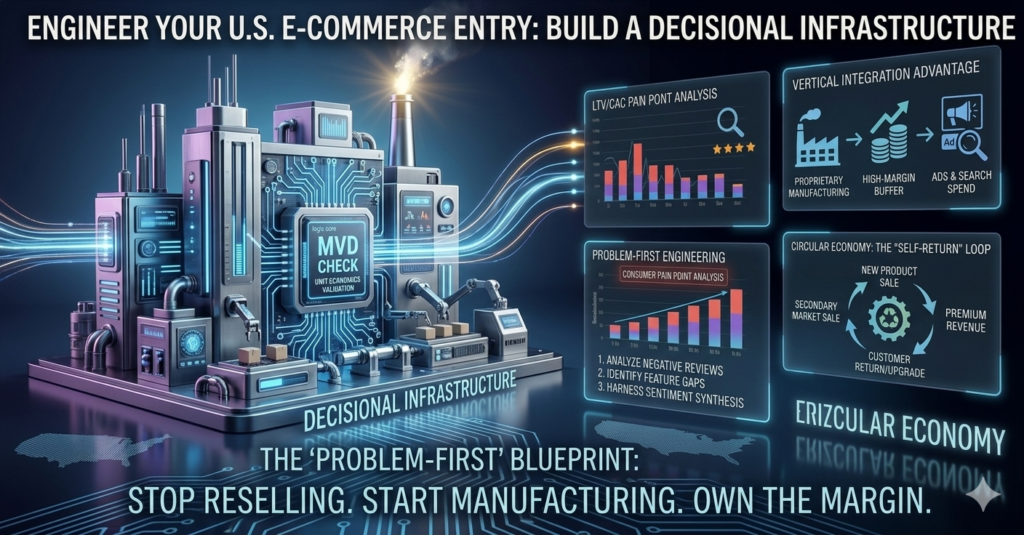
The US e-commerce landscape is no longer a gold rush; it is a war of efficiency. Most founders hit a «Dead End» because they follow the generic advice found on Shopify or Google: «Find a trending product, run ads, and scale.» In 2026, that is the fastest way to burn your capital. When everyone has access to the same Alibaba suppliers and the same Meta ad sets, your margin isn’t protected by your product—it’s protected by your Decisional Infrastructure. If you don’t have a forensic view of the competition, you aren’t building a business; you are just financing Mark Zuckerberg’s next yacht.
1. Identifying Saturated vs. Underserved Gaps
A market only feels saturated when you are looking at it through the lens of «Averages.» If you look at the «Fitness» category, it looks full. But if you analyze the Competitor Shortcoming Matrix, you’ll find that while there are 1,000 brands selling dumbbells, there are zero brands solving the specific ergonomic pain points mentioned in 2,000 forgotten 2-star reviews. Avoiding saturation isn’t about finding a new category; it’s about finding the Fracture Points where current leaders have become complacent and slow to react to consumer dissatisfaction.
- Sentiment Synthesis: We process thousands of reviews to find the «Breaking Point» of the market leaders.
- Search Volume Arbitrage: Identifying rising intent in sub-niches before they become «trending» and expensive.
- Toxic SKU Detection: Spotting products that look like winners but bleed net margin due to high returns (RMA).
2. The Power of Hyper-Segmentation (Niche Down)
The biggest mistake is trying to be «comparable.» If a customer can compare your price to another brand, you have already lost. You must «Niche Down» until the competition disappears. This isn’t just about marketing; it’s about Psychological Ownership of a subculture. When you target «Tactical Gear for New Fathers» instead of just «Baby Gear,» you aren’t competing with Amazon; you are building a specialized vertical where price sensitivity is replaced by brand identity. This creates a moat that no generalist competitor can cross without spending millions in rebranding.
- Specialized Sub-Niches: Targeting hyper-specific cohorts (e.g., Urban Apartment Gyms).
- Regional Demand Gaps: Using localized US data to find geographic «Black Holes» with high demand.
- Passion-Led Communities: Aligning with subcultures that value expertise over «cheap» alternatives.
3. The Manufacturer’s Edge: Vertical Integration
The only way to escape the «Averages Trap» is to own the source. If you are reselling what everyone else is reselling, your death is a matter of time. High-scale e-commerce in the USA now requires Proprietary Manufacturing. This allows you to protect your margins against the skyrocketing costs of Google Search and Meta Ads. Furthermore, elite brands are now utilizing Circular Economics: manufacturing their own goods and then «self-returning» that inventory to a secondary «Refurbished» market. You capture the high-ticket customer and the budget-conscious customer simultaneously, using the same manufacturing line.
- Manufacturing Control: Iterate 10x faster than competitors relying on generic sourcing.
- High-Margin Buffer: Building the necessary spread to survive 2026 ad costs.
- The Circular Profit Loop: Capturing the secondary market to protect the primary brand’s value.
4. Engineering High Entry Barriers (The Niche of One)
Saturation is a symptom of a low barrier to entry. If anyone can copy your product in 24 hours, you don’t have a business. You need to differentiate so severely that you become Non-Comparable. This is achieved by identifying the «Feature Gaps» that your competitors are too heavy to fix. Whether it’s a disruptive unboxing experience, a radical pricing architecture, or a superior logistical speed, these operational moats ensure that even if a competitor copies your product, they cannot copy your Unit Economics or your customer loyalty.
- Non-Comparable Branding: Eliminating price competition by becoming the «only» solution.
- Feature Gap Exploitation: Building your brand around the one thing competitors ignore.
- Operational Efficiency: Turning logistics and unboxing into a competitive advantage.
5. Validation through Minimum Viable Data (MVD)
Before you commit a single dollar to inventory or ship a container to a US 3PL, you must de-risk the launch. Most founders launch and then look at the data; we do the opposite. By calculating the LTV/CAC Variance before the first sale, we can predict if a category is a gold mine or a trap. We run small-scale, clinical ad tests to measure the real cost of acquisition, ensuring that you aren’t entering a crowded room where the «cost of entry» is higher than the potential profit.
- LTV/CAC Variance: Real-world projections of sustainability in your specific niche.
- Market Testing: Small-scale validation to measure real-world demand before the big spend.
The «Deep Expert» Verdict: Start Engineering Today.