
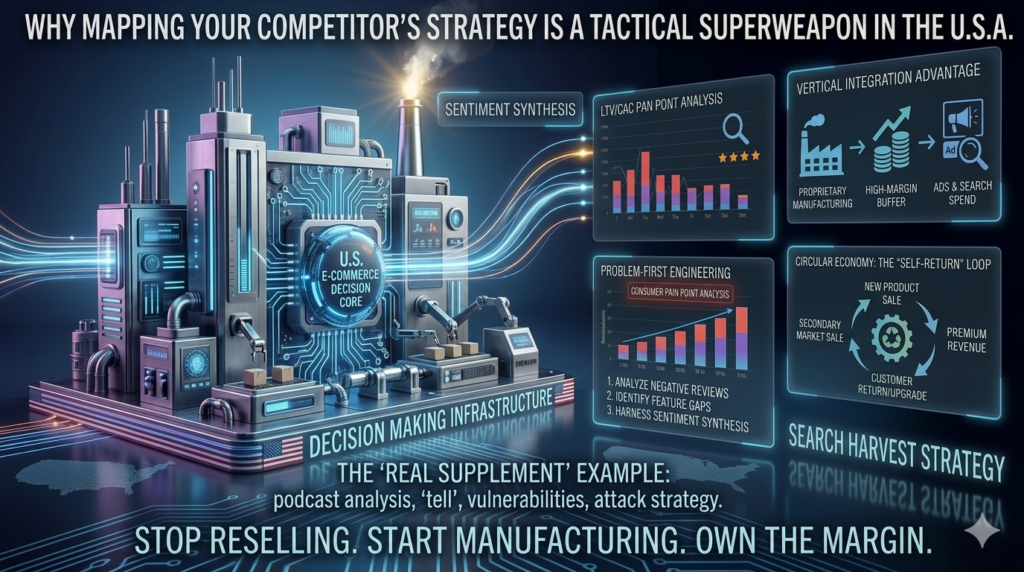
Avoiding a saturated market in the USA requires shifting from a «product-first» approach to a «problem-first» approach, focusing on underserved niches and leveraging data to identify growth potential with limited competition. Before launching, you must analyze market gaps by evaluating what is already available and identifying customer pain points that current leaders ignore. This competitive mapping isn’t just research; it’s the only way to avoid stagnant growth and shrinking margins.
The Anatomy of Strategic «Tells»: Knowing the Game
A simple gesture—understanding the specific objective of their Meta Ads, Google Search, YouTube sponsorships, or Podcasts—reveals their entire «Playbook.» When you audit their media mix, you aren’t just looking at creative; you are identifying their Burn Rate and their Acquisition Moat. If they are heavy on YouTube podcasts but invisible on Google Search, they aren’t selling a product; they are building a «Lifestyle Moat» because they know their Unit Economics can’t survive a direct bidding war on keywords. Knowing «what game they are playing» allows you to choose a battlefield where they are weak.
Real Market Example: The «Premium Supplement» Battle
Imagine a competitor in the Nootropics space. They are sponsoring high-end health podcasts and running «Brand Awareness» ads on Meta with high-production video.
- The «Tell»: They are over-indexing on «Authority.» This means their CAC is likely high, but they are betting on a massive LTV through subscriptions.
- The Vulnerability: Because they spend so much on top-of-funnel (Podcasts), they often neglect Bottom-of-Funnel Search.
- The Attack: You deploy a Search Harvest Strategy. You target the specific long-tail comparisons and the negative keywords related to their delivery times. You capture the demand they created at 1/10th of the cost.
[STRATEGIC INTELLIGENCE: REACTIVE VS. FORENSE]
| Tactical Factor | Reactive Brand (Average) | Deep Expert (Engineering) |
| Pricing Strategy | Matches the leader’s price | Identifies their margin «floor» and breaks it |
| Media Mix | Mimics their Ad platforms | Attacks the «Search Gaps» they ignore |
| Logistics | Ships and prays | Exploits competitor stock-outs (Arbitrage) |
| Product Roadmap | Copies the Best-Seller | Fixes the Top 3 complaints of the leader |
Sentiment Synthesis: Their 1-Star Reviews are Your Blueprint
A competitor’s negative feedback is a direct instruction manual for your product development. Analyzing negative reviews on Amazon or Reddit reveals specific gaps in quality, features, or service.
- Fracture Points: We identify the exact moment a customer loses trust in the leader.
- Problem-First Engineering: We fix what they are too slow to change.
- Unit Economics Validation: We analyze if their low prices are subsidized by a 20% return rate (RMA).
Engineering the «Niche of One» through Funnel Forensics
The ultimate advantage of knowing their strategy is knowing how to be Non-Comparable. When you deconstruct their funnel—from the first Ad to the unboxing—you find the «Friction Points» they’ve ignored for years.
- Funnel Forensics: Auditing their email flows and upsell sequences to find where they «drop» the customer.
- MVD (Minimum Viable Data): Validating your entry against their historical failure points before you commit a single dollar to inventory.
The «Deep Expert» Verdict: Start Engineering Today.
Don’t fight the competition. Use their own data to build the «Decisional Infrastructure» that makes them obsolete.