
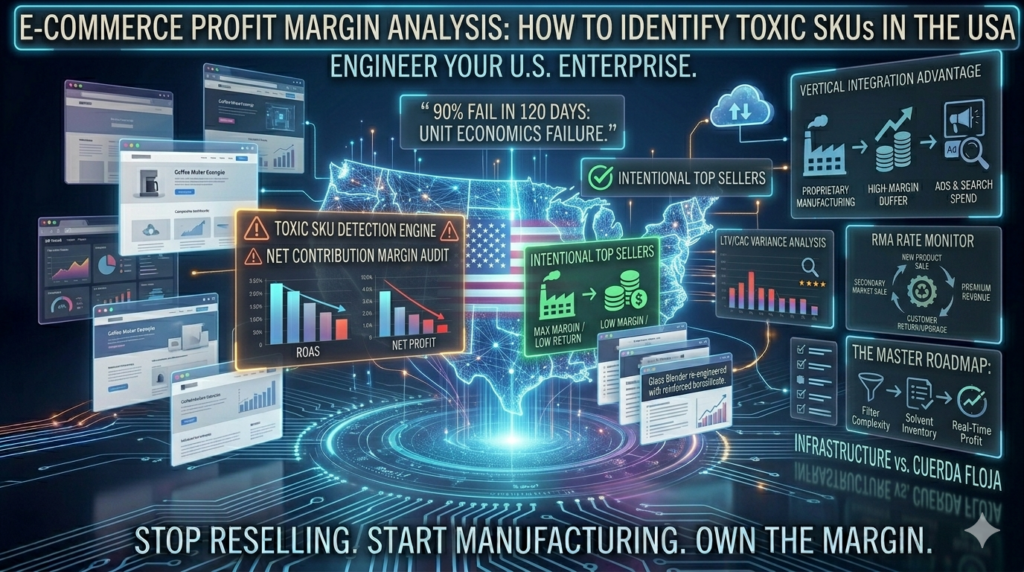
To identify Toxic SKUs in the US market, you must perform a clinical audit that cross-references Net Contribution Margin against LTV/CAC Variance and RMA (Return) rates. A Toxic SKU is a high-volume product that appears profitable due to a strong ROAS but actually bleeds capital through high operational friction and hidden logistics costs. By deploying a Market Deep Dive, you can isolate these «margin killers» and pivot your inventory toward high-retention, proprietary manufactured goods that ensure long-term solvency.
The Breakdown: When High Demand Equals High Risk
Actionable data-driven decision making requires a clinical breakdown of your inventory. A «Toxic SKU» is often the result of ignoring the Breaking Point in consumer behavior. You might be capturing demand, but if the product has a «Feature Gap» that leads to a 15% return rate or requires constant customer support, your «efficiency» is an illusion. In the USA, where logistics and labor are expensive, operational friction is the silent killer of the E-commerce dream.
Easy Understanding Example: The «Eco-Friendly Glass Blender»
Imagine you sell a high-end blender that is a hit on TikTok. Your ROAS is 4.5x and the orders are flying in.
- The Surface View: You think you should double the budget because «it’s working.»
- The Deep Dive Intelligence: Analysis reveals that 20% of customers return the product because the glass pitcher breaks during high-speed cleaning—a Feature Gap the leader has ignored for years.
- The Financial Reality: Between the cost of shipping the return, the refurbished loss, and the «Toxic» customer sentiment, you are losing $5 per unit sold despite the high ROAS.
- The Engineering Solution: You identify this «breaking point» in competitor reviews, re-engineer the base with reinforced borosilicate, and adjust your pricing to a premium tier. You turn a Toxic SKU into a High-Margin Pillar.
[THE UNIT ECONOMICS INFRASTRUCTURE: VANITY VS. REALITY]
| Metric | The Vanity Approach (Reactive) | The Deep Expert (Engineering) |
| Primary KPI | ROAS (Top-line revenue) | Net Margin contribution (Bottom-line) |
| SKU Management | Focuses on «Best Sellers» | Identifies and purges «Toxic SKUs» |
| Competitor Analysis | Looks at their Ads/Creatives | Analyzes their Stock Latency Arbitrage |
| Inventory Risk | Buys based on «Hype» | Validates Unit Economics before capital commit |
Stock Latency Arbitrage: Capturing Demand in the «Vacuum»
Competitive Intelligence isn’t just about what they sell, but when they stop selling. Mapping a competitor’s Stock Latency allows you to identify the 48-72 hour windows where they run out of inventory. During these «Stock-Out Vacuums,» the cost of customer acquisition (CAC) drops significantly because the dominant player has stopped spending.
- Granular Insight: We identify the exact cohorts that are left «homeless» when a leader fails to fulfill.
- Tactical Strike: We deploy your ads exactly in that vacuum, capturing high-intent demand with zero bidding war.
- Risk Mitigation: Instead of fighting for «Breadth,» we fight for «Depth» in the gaps the leaders leave behind.
Navigating the USA Market: Risk Mitigation through Validation
The US market moves too fast for «trial and error.» Navigating economic risks requires validating the Unit Economics of a category before committing a single dollar to inventory. A Deep Dive uncovers the «Feature Gaps» and internal friction points that competitors are too slow to respond to. By the time they realize they have a problem, you have already engineered the solution through Proprietary Manufacturing.
- Cohort-Based Analysis: Understanding the behavior of your most profitable customers vs. the «one-time» buyers.
- LTV/CAC Variance: Engineering a product cycle that ensures the second purchase is where the true profit lies.
Market Reality: The Cost of Poor Infrastructure
«Statistics show that 90% of e-commerce startups fail within the first 120 days; however, it isn’t due to a lack of traffic, but rather a failure in operational unit economics and poor inventory management of low-margin products.» — Source: Forbes / Marketing Signals Research.
Strategic Analysis: You Control the Scale
If a Toxic SKU reaches «Top Seller» status in your store, it is because your infrastructure allowed it to happen. This is not a market error; it is a failure of internal logic. The hallmark of an expert is ensuring that only products with the maximum net margin and the lowest return rates occupy the top of the sales funnel. Your ability to scale effectively depends entirely on the data points you choose to prioritize.
The Master Roadmap: Engineering for Real-Time Profit
To avoid operating on a «tightrope,» you must implement a framework that prevents bad habits and filters out non-performing products before they drain your capital. A solid infrastructure allows you to:
- Filter Operational Friction: Identify and purge complex or low-performing products before they reach your inventory. If the system doesn’t filter these out, the failure is in the design, not the market.
- Real-Time Optimization: A robust foundation enables you to capitalize on market shifts, making decisions that improve profit and scalability in near real-time.
- Intentional Top Sellers: You are the architect of your catalog. A true «Top Seller» is a product intentionally engineered for high margins and low returns. Scaling a mediocre product is a choice to sabotage your own growth.